
The City of Seven Hills
Spray Foam Insulation in Yonkers, NY
Westchester's biggest city, with housing from the 1800s to last year and most of it leaky somewhere.
- Free on-site estimates
- Written quote listing material, thickness and R-value for every area
- Air leaks, moisture and old insulation checked before anything is covered
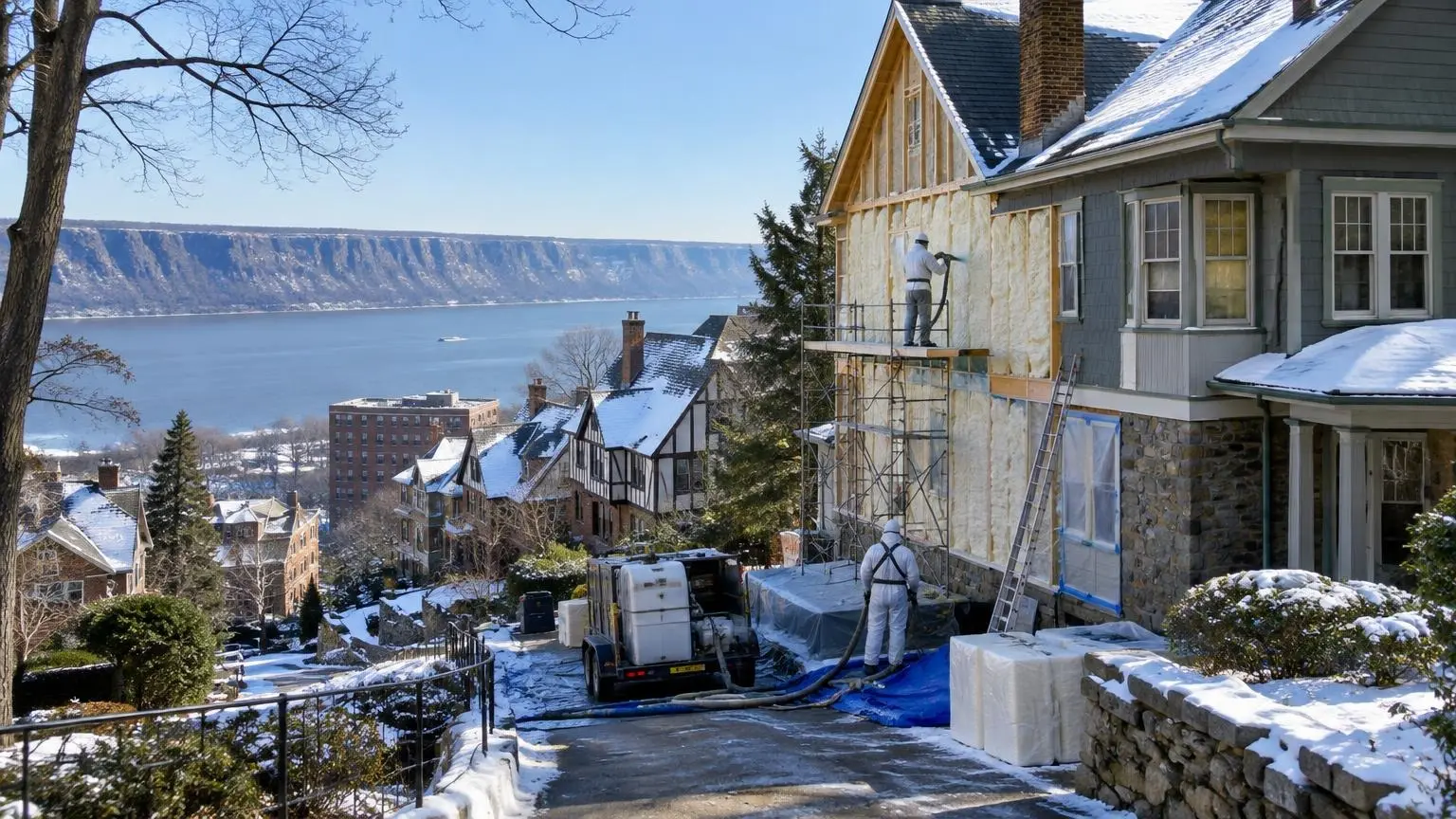
Insulating a City of Old Houses and Steep Streets
Spray Foam Insulation in Yonkers starts with the age of the housing. The city counted 211,569 residents in 2020, its highest census total, and survey data for 2019 to 2023 counts about 85,000 housing units with a median build year of 1958. Roughly a quarter of those units predate 1940, and another 18.4% went up in the 1950s. That mix of prewar frame houses, postwar Capes and two-families, and apartment buildings means the leaks and the fixes vary block by block.
Four quarters, four kinds of house
The Saw Mill River splits Yonkers into quarters, and each has its own housing. Northwest Yonkers has many Victorian-era homes looking across the Hudson to the Palisades, with tall walls, open stud bays and attics that were never sealed. The northeast, around Crestwood, Colonial Heights and Lawrence Park West, ranges from small, closely spaced houses to larger ones, with mid-rise apartments along Central Avenue. The southwest, from Getty Square to Park Hill and Nodine Hill, is denser and older, and the southeast around Dunwoodie mixes one- and two-family homes. We plan attic, wall and basement work around whichever of those you live in.
Hills, wind and stairs
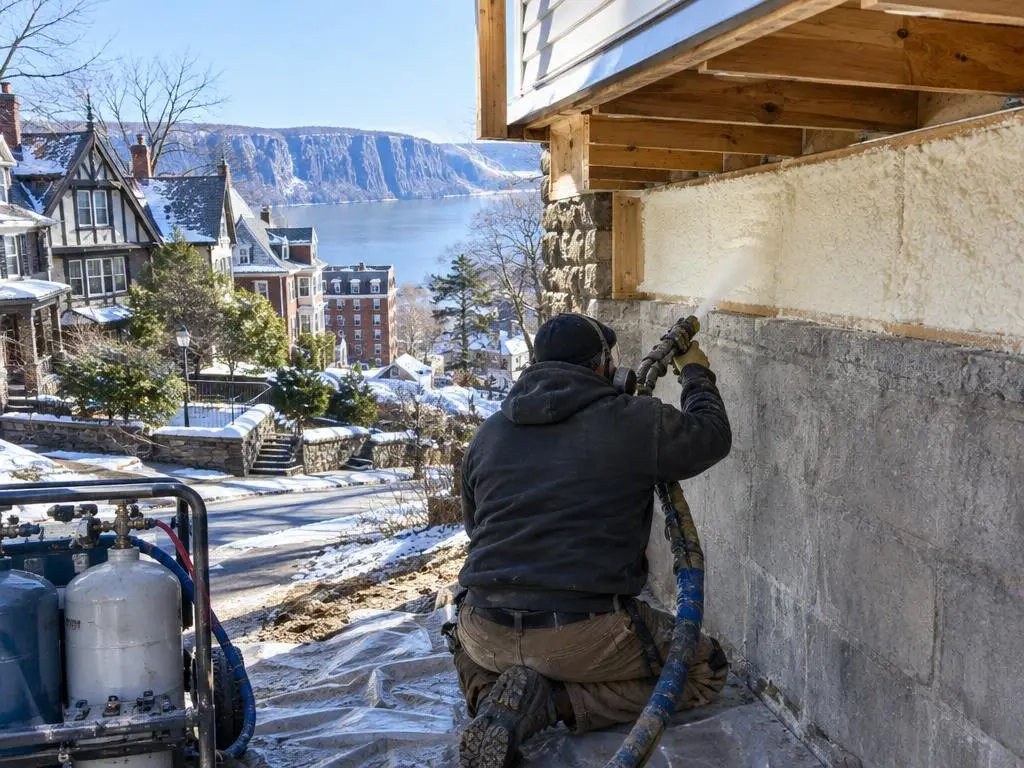
Yonkers climbs from near sea level at the river to 416 feet at Sacred Heart Church, which is why it is called the City of Seven Hills. Houses on the ridges catch the wind, and houses on slopes often have one basement wall fully below grade and another partly exposed. The exposed side is where rim joists and foundation walls lose the most heat. Steep driveways and stairs also matter for us: they change how hoses are run and how long a job takes, and we price that honestly after seeing the site.
Owners and landlords
About 46% of occupied units in the city are owner-occupied and 54% are rented, according to the same survey data. Owner-occupants usually call about a hot top floor or a cold first floor. Owners of two-families and small rental buildings usually want even heat across units and fewer complaints. Both start with the same visit: attic, basement, walls and a written quote.
A typical Yonkers visit
In a prewar house on Park Hill or in Nepera Park, we usually start in the attic and find old loose fill a few inches deep, open chases beside the chimney and a hatch with no weatherstripping. In the basement the rim joist is bare or stuffed with a dusty batt. In a 1950s Cape near Dunwoodie or Crestwood, the story shifts to the half-story bedrooms: kneewalls with nothing behind them and a narrow attic above. In both cases the quote lists sealing, attic insulation, kneewalls and rim joist as separate lines, so you can start with the area that bothers you most.
What applies here
Yonkers follows the New York State energy code, not New York City's, even though it borders the Bronx. The state code's county table puts Westchester in Climate Zone 4, with R-49 listed for ceilings. Con Edison's Weather Ready program is closed to new applications, and NYSERDA's Comfort Home program lists packages for Westchester homeowners that pair attic and rim joist work. Get a free estimate
What to Know in Yonkers
- Housing age. Survey data for 2019 to 2023 puts the median year built in Yonkers at 1958, with 26.6% of about 85,000 units built before 1940 and 18.4% in the 1950s.
- Hills and rivers. Known as the City of Seven Hills, Yonkers rises from the Hudson to 416 feet at Sacred Heart Church; the Bronx River forms its eastern border and the Saw Mill River divides the city.
- Population. The 2020 census counted 211,569 residents, the highest in the city's history, up from 195,976 in 2010.
- Tenure. About 46.2% of occupied units are owner-occupied and 53.8% are rented (2019 to 2023 survey estimates).
- State code, Zone 4. Yonkers follows the Energy Conservation Construction Code of New York State; its county table lists Westchester in Climate Zone 4.
Yonkers Questions
Do you work in every Yonkers neighborhood?
Yes, from Getty Square, Park Hill and Nodine Hill to Crestwood, Dunwoodie, Nepera Park and the northeast. Call (914) 785-6679 to set up a visit.
Can you insulate a two-family house in Yonkers?
Yes. Two-families usually share one attic and one basement, so sealing and insulating those spaces helps both units. We quote each area separately so the owner can see what it costs.
How long does a typical Yonkers attic and rim joist job take?
Most single-family attic and rim joist jobs take one to two days, depending on size, access and how much sealing is needed. Spray foam areas need the house to be empty for the time the product requires, which we confirm in advance.
Do you insulate houses on the steep streets near the river?
Yes. Hillside houses are common in Yonkers. We plan hose runs and equipment placement during the visit and include any extra time in the written price.
Does Yonkers use the NYC energy code?
No. Yonkers follows the New York State energy code, which places Westchester in Climate Zone 4. Permits go through the city's building department.
Free Estimates in Yonkers, NY
Anywhere in Yonkers: book a free estimate.
Spray Foam Insulation Near Yonkers
- Spray Foam Insulation in Mount Vernon, NY
- Spray Foam Insulation in New Rochelle, NY
- Spray Foam Insulation in White Plains, NY
- Spray Foam Insulation in Bronxville, NY
- Spray Foam Insulation in Scarsdale, NY
- Spray Foam Insulation in Eastchester, NY
- Spray Foam Insulation in Tuckahoe, NY
- Spray Foam Insulation in Pelham, NY
- Spray Foam Insulation in Larchmont, NY
- Spray Foam Insulation in Hastings-on-Hudson, NY
- Spray Foam Insulation in Dobbs Ferry, NY
- Spray Foam Insulation in Ardsley, NY
- Spray Foam Insulation in Irvington, NY
- Spray Foam Insulation in Tarrytown, NY
- Spray Foam Insulation in Mamaroneck, NY