
Open cell or closed cell, by location
Spray Foam Insulation in Yonkers, NY
Foam that seals and insulates in one pass, used where it does more than cheaper materials can.
- Free on-site estimates
- Written quote listing material, thickness and R-value for every area
- Air leaks, moisture and old insulation checked before anything is covered
Where Spray Foam Makes Sense
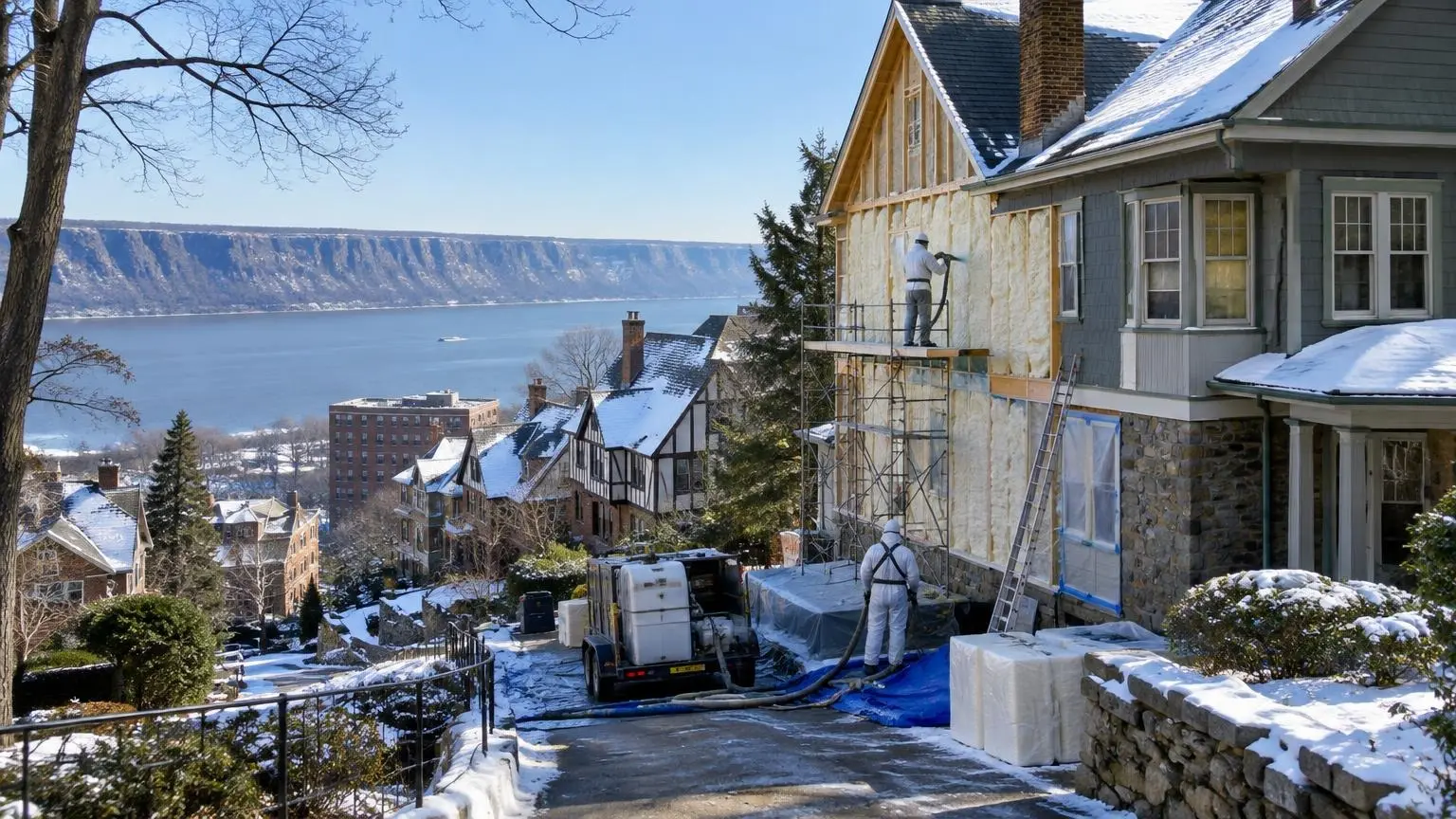
Spray foam insulation is a two-part liquid that reacts and expands as it is sprayed, filling the cavity and bonding to wood, masonry and sheathing. That bond is the point. Fiberglass and cellulose slow heat, but air moves around and through them; foam stops the air at the same time. In a Yonkers house built before the war, where air leaks are often a bigger problem than missing insulation, that makes foam the right tool in a handful of specific places.
Open cell
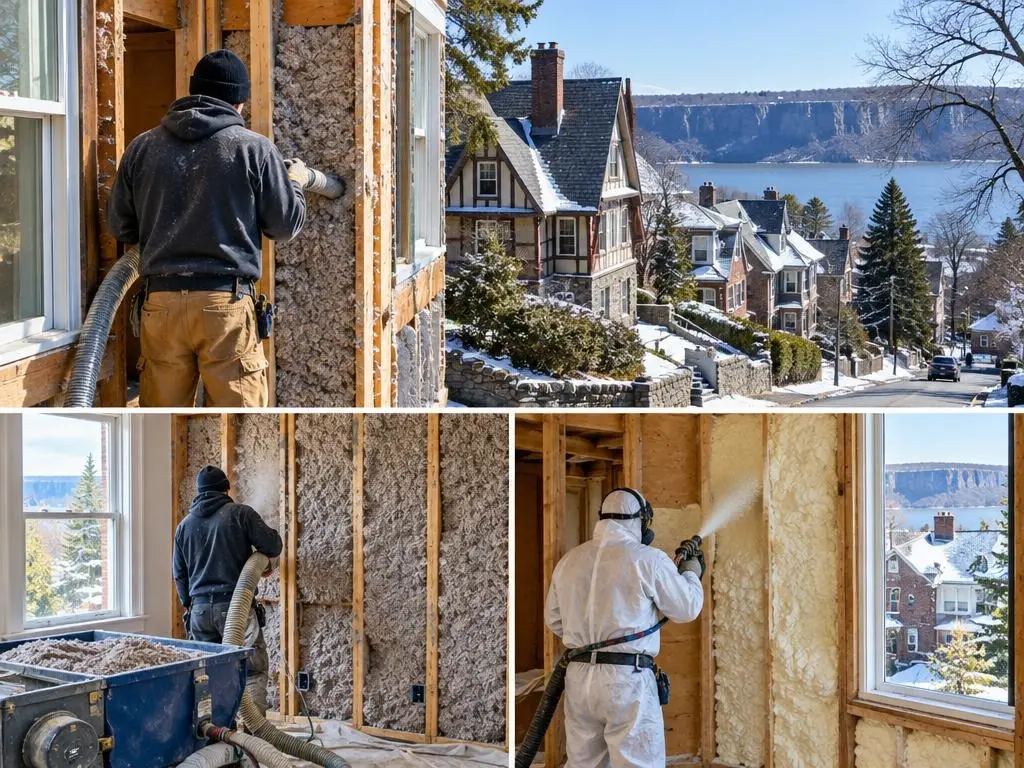
Open-cell foam weighs about half a pound per cubic foot and expands a great deal, which lets it fill irregular rafter bays and wrap around wiring and blocking. HomeGuide lists it at R-3.5 to R-3.7 per inch. It is a strong air barrier and it quiets sound, but water vapor can pass through it, so it needs the right conditions on the cold side. We use it most for the underside of the roof deck over finished attic rooms and for open stud walls during a gut renovation.
Closed cell
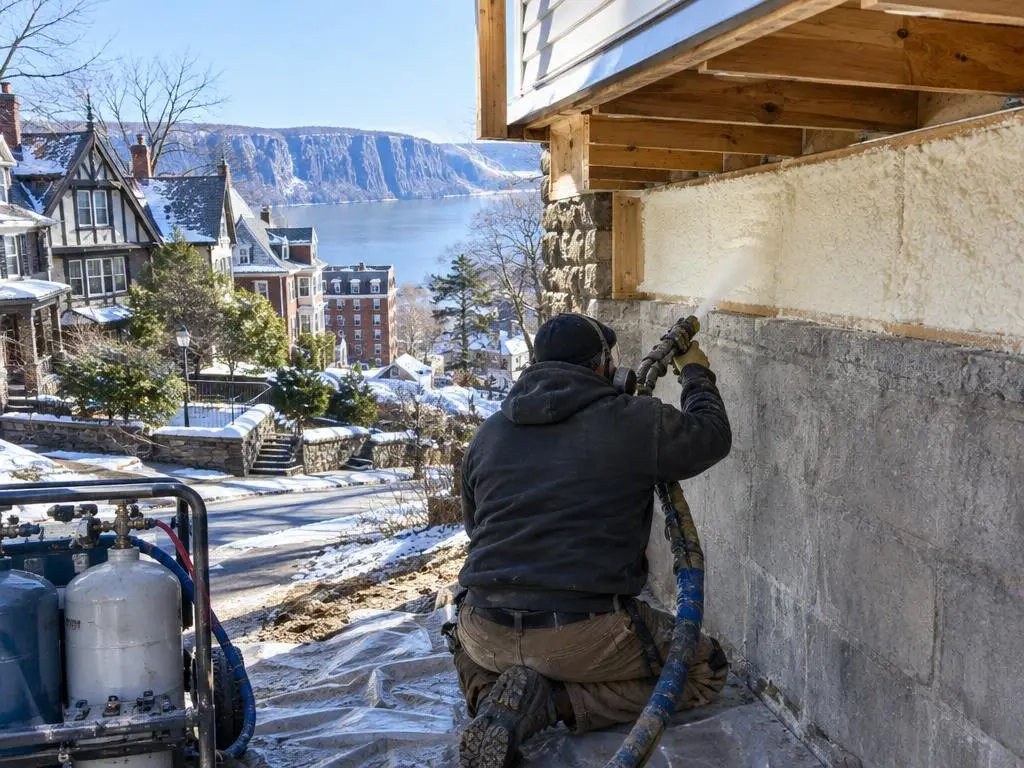
Closed-cell foam is about two pounds per cubic foot, rigid when cured, and rated R-5 to R-7 per inch by HomeGuide. At normal thickness it acts as a vapor retarder and does not absorb water. That is why it goes on rim joists, foundation walls, the ceiling of a garage under a bedroom, and roof slopes too shallow to fit vent channels plus enough fluffy insulation to reach the target R-value. It costs more per square foot, so we put it where its density matters.
When foam is not the answer
On a wide-open attic floor with good access, sealing the top plates and penetrations and then blowing in deep cellulose or fiberglass usually reaches R-49 for less money. In a closed plaster wall, standard spray foam cannot be applied at all; dense-pack cellulose or an injection foam goes in through small holes instead. We will tell you when a cheaper option makes more sense.
Safety and the day of the job
While foam is sprayed and curing, the area is closed off and ventilated and people and pets stay out. HomeGuide advises being out of the house for at least 24 hours with many products; we tell you the exact time for the product we use. Foam inside living space must be covered by a thermal barrier such as drywall, and foam in attics and crawl spaces needs an ignition barrier or a product rated for that use. We plan for that in the quote.
What This Covers
The places in a southern Westchester house where foam earns its price.
Roof line over finished attics
Open-cell or closed-cell foam on the underside of the roof deck when the attic holds bedrooms, an office or mechanical equipment.
Rim joists and sills
Closed-cell foam along the band joist and sill plate, where cold air enters most basements in the area.
Garage ceilings and cantilevers
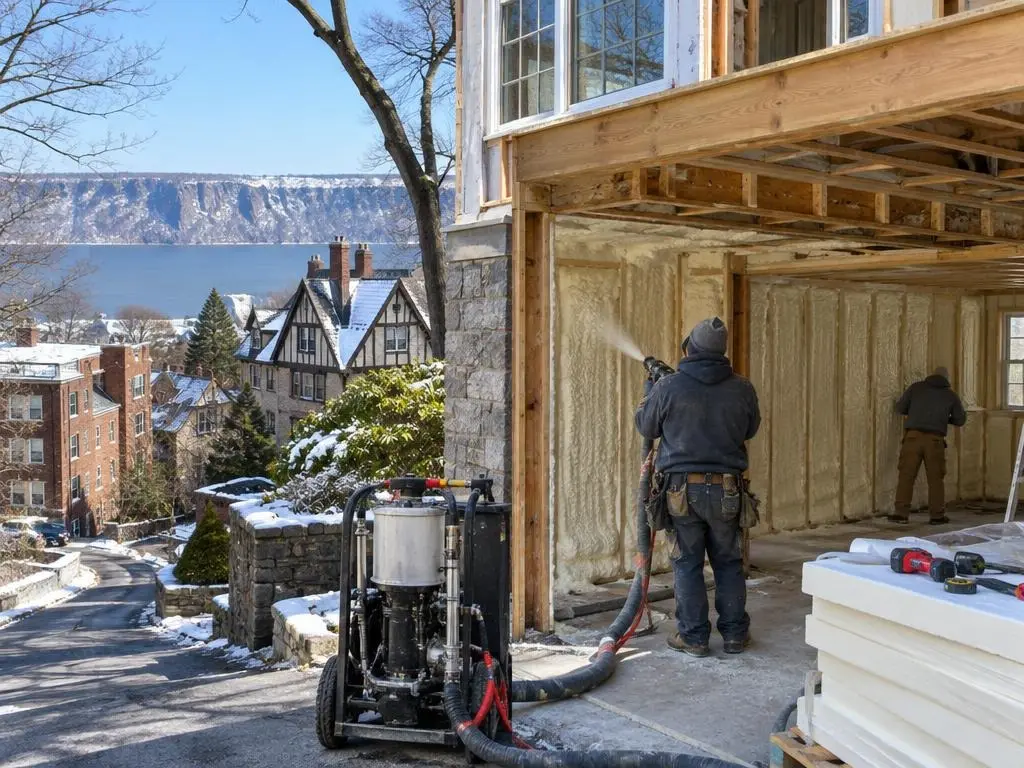
Closed-cell foam under rooms that sit over a garage or hang past the foundation, so the floor above stays warm.
Open walls during renovation
Foam in exposed stud bays while walls are open, then drywall over it as the code requires.
Hard-to-reach air leaks
Foam sealing at chases, flues (with proper clearances and metal flashing), plumbing stacks and kneewall bases.
Published Spray Foam Insulation Costs
| Job | Range and source |
|---|---|
| Spray foam, installed | $1.50 to $5.00 per sq ft (HomeGuide) |
| Open-cell / closed-cell | $1.50 to $3.50 / $3.00 to $5.00 per sq ft (HomeGuide) |
| About 1,000 sq ft | $1,500 to $5,000 (HomeGuide); $3,150 to $7,500 existing home (Fixr) |
| Existing walls / new construction | $3.15 to $7.50 / $2.75 to $6.50 per sq ft (Fixr) |
| All exterior walls | $4,000 to $10,000 (HomeGuide) |
| Whole house | $8,000 to $20,000 (HomeGuide); $10,000 to $30,000 (Fixr) |
| Typical job minimum | $1,000 to $2,000+ (HomeGuide) |
National figures from HomeGuide's 2026 spray foam guide and Fixr's 2025 guide. Foam type, thickness, access, prep and code coverings move the total, and small jobs often meet a minimum. The number on your written estimate is the number you pay.
How It Works
1. Visit and measure
We look at each space, measure it, check for moisture and roof leaks and note wiring, flues and existing insulation.
2. Written quote
Each area is listed with foam type, thickness, target R-value, any covering needed and the price.
3. Prep and spray
We cover floors and belongings, close off and ventilate the area, then spray to the thickness on the quote.
4. Check and clean up
We measure thickness, trim where needed, clean up and tell you when it is safe to be back inside.
Why Choose Us for Spray Foam Insulation
Foam only where it pays
If blown-in or dense-pack does the job for less, the quote says so.
Thickness written down
You see the planned inches and R-value for every area before work starts.
Coverings planned
Thermal or ignition barrier needs are part of the quote, not a surprise later.
Spray Foam Insulation Questions
What is the difference between spray foam and regular insulation?
Regular insulation such as fiberglass or cellulose slows heat but lets air pass through and around it. Spray foam bonds to the framing and stops air movement as well as slowing heat. That is why foam is used where air leaks are concentrated, like rim joists and roof lines.
How long do I need to stay out after spraying?
It depends on the product. HomeGuide advises vacating for at least 24 hours with many foams. We give you the exact time for the product on your job and ventilate the work area.
Can spray foam go over old insulation?
Not usually. Foam needs to bond to clean framing or sheathing, so old batts are pulled out of the areas being foamed. Removal is listed as its own line on the quote.
Will spray foam stop a roof leak?
No, and it can hide one. Roof leaks are fixed by a roofer first. We check for stains and damp sheathing before spraying any roof line.
Spray Foam Insulation Service Areas
- Spray Foam Insulation in Yonkers, NY
- Spray Foam Insulation in Mount Vernon, NY
- Spray Foam Insulation in New Rochelle, NY
- Spray Foam Insulation in White Plains, NY
- Spray Foam Insulation in Bronxville, NY
- Spray Foam Insulation in Scarsdale, NY
- Spray Foam Insulation in Eastchester, NY
- Spray Foam Insulation in Tuckahoe, NY
- Spray Foam Insulation in Pelham, NY
- Spray Foam Insulation in Larchmont, NY
- Spray Foam Insulation in Hastings-on-Hudson, NY
- Spray Foam Insulation in Dobbs Ferry, NY
- Spray Foam Insulation in Ardsley, NY
- Spray Foam Insulation in Irvington, NY
- Spray Foam Insulation in Tarrytown, NY
- Spray Foam Insulation in Mamaroneck, NY
Get a Spray Foam Insulation Estimate
Find out where foam belongs in your house and what it costs.